
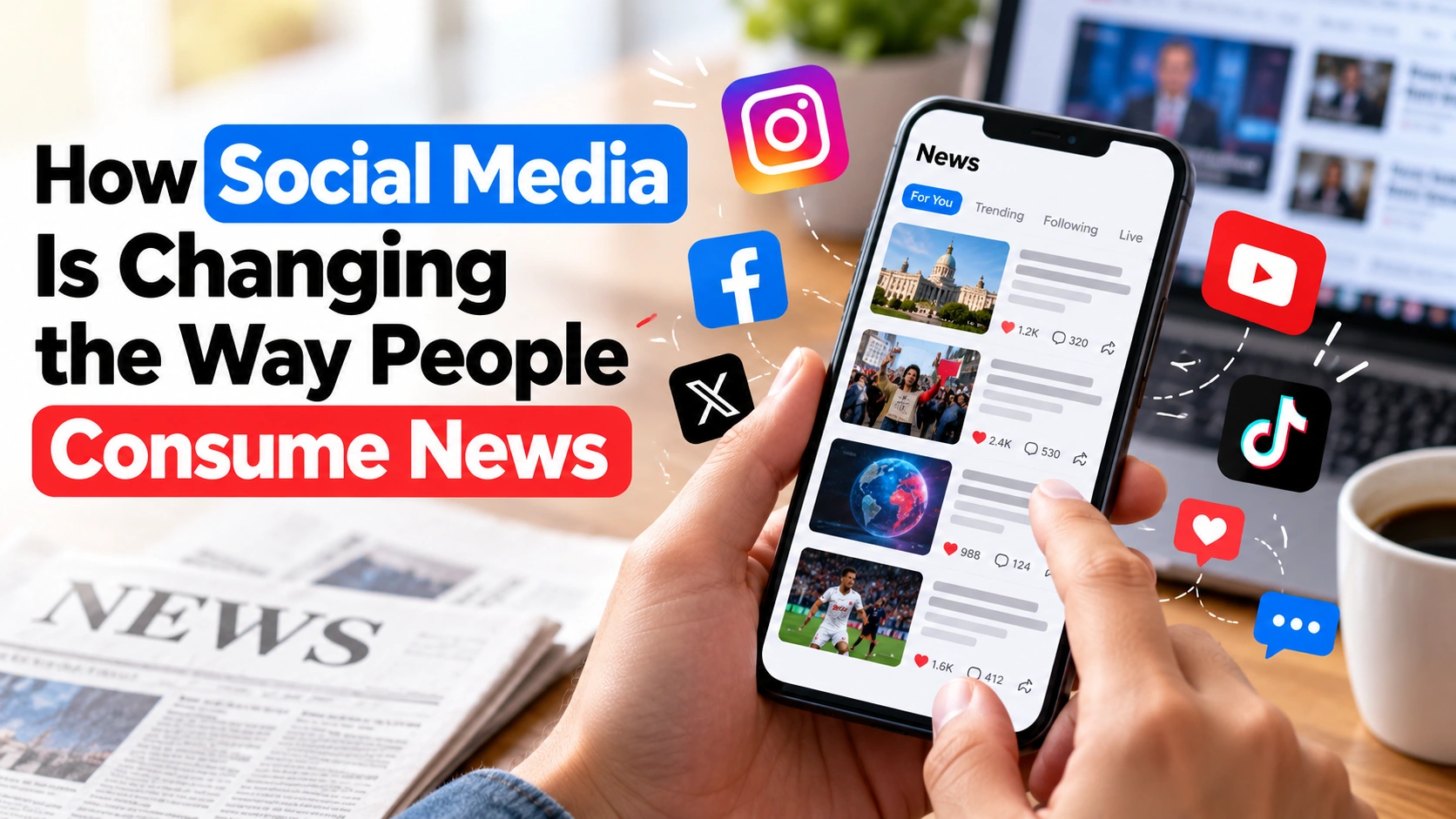
How Social Media Is Changing the Way People Consume News

September 28, 2026
Social media has changed how people discover, discuss, and share news. In the past, many people relied on newspapers, television broadcasts, radio, or dedicated news websites to find out what was happening. Today, a news story can appear in a person’s social media feed within minutes of an event occurring.
Platforms built around short posts, videos, images, and recommendations have made news more accessible and immediate. At the same time, the way people encounter information online creates new challenges, including misinformation, limited context, and the difficulty of distinguishing reporting from opinion.
News Is Available Almost Instantly
One of the biggest changes brought by social media is speed. When a major event occurs, people may see posts, photographs, videos, or updates almost immediately.
This can be useful during breaking news situations because people can quickly learn that something has happened. Journalists, government agencies, organizations, and individuals can all publish updates without waiting for the next newspaper edition or scheduled television broadcast.
However, speed can also mean that early information may be incomplete. Initial reports can change as journalists verify facts and gather additional information.
People Often Discover News Through Their Feeds
Social media feeds have become an important discovery mechanism for many users. Instead of deliberately visiting a news website, someone may encounter a news story while scrolling through posts from friends, creators, organizations, and publishers.
This changes the traditional relationship between audiences and news. People may encounter stories they were not actively searching for, while other important stories may receive less attention depending on what appears in their feeds.
The presentation also matters. A headline, photograph, short video, or post can encourage someone to click and learn more—or simply react and move on.
Short-Form Content Influences Attention
Many social platforms encourage concise content. News organizations have adapted by producing short videos, graphics, summaries, and brief posts designed for mobile screens.
This can make complicated subjects easier to approach. A short explainer may introduce an issue to someone who would not read a lengthy article.
However, complicated topics can require context. A short post may leave out background information, opposing perspectives, or important details. Readers who want to understand an issue fully may need to consult longer articles and multiple reliable sources.
Algorithms Influence What People See
Social media platforms use recommendation systems to determine which posts appear in users’ feeds. These systems may consider factors such as previous interactions, interests, viewing behavior, and other signals.
As a result, two people can use the same platform and see very different collections of stories. The information someone encounters is therefore influenced not only by what publishers produce but also by how platforms organize and recommend content.
Understanding this can encourage users to actively seek information rather than relying entirely on their automatically generated feeds.
Anyone Can Share Information
Social media has reduced the barriers to publishing information. Ordinary users can share photographs, videos, observations, and personal experiences from events happening around them.
Citizen-generated content can provide valuable perspectives, particularly when people are present at an event before professional journalists arrive. At the same time, a person’s firsthand observation may not explain the full context of what is happening.
A photograph or video can be genuine while still being misunderstood if its location, date, or surrounding circumstances are unclear.
Misinformation Can Spread Quickly
The same speed that makes social media useful for news can also help inaccurate information spread. Incorrect claims, edited images, misleading headlines, and old content presented as new can circulate widely.
Users can reduce the risk of accepting false information by checking the source, looking for independent reporting, checking publication dates, and reading beyond headlines.
Information that produces a strong emotional reaction deserves particular attention before being shared.
News and Opinion Can Become Blended
Traditional news reporting generally aims to distinguish factual reporting from commentary, although different outlets have different editorial approaches. On social media, news reports, personal opinions, satire, advertisements, and user-generated content can appear next to one another.
This can make it difficult for users to identify what type of content they are viewing.
Checking the publisher and reading the full article can help clarify whether a post is reporting an event, interpreting it, or expressing someone’s personal opinion.
Social Media Encourages Public Discussion
News is no longer simply something people read or watch. Social media allows users to immediately respond, comment, debate, and share their interpretations.
This can create opportunities for people to encounter perspectives they might not otherwise see. However, online discussions can also become highly polarized or confrontational.
Approaching disagreements carefully and checking claims before repeating them can contribute to more constructive conversations.
Developing Better News Habits
People can make social media a more useful source of information by following a variety of credible publishers, checking sources, reading beyond headlines, and comparing important claims across multiple reliable sources.
It is also useful to distinguish between breaking information and confirmed information. The earliest post is not necessarily the most complete or accurate account.
Conclusion
Social media has transformed news consumption by making information faster, more interactive, visual, and personalized. It has expanded opportunities for people and organizations to share information while also introducing challenges related to misinformation, context, algorithms, and the blending of news with opinion. By approaching online information thoughtfully and verifying important claims, users can benefit from the accessibility of social media while developing more informed news-consumption habits.