
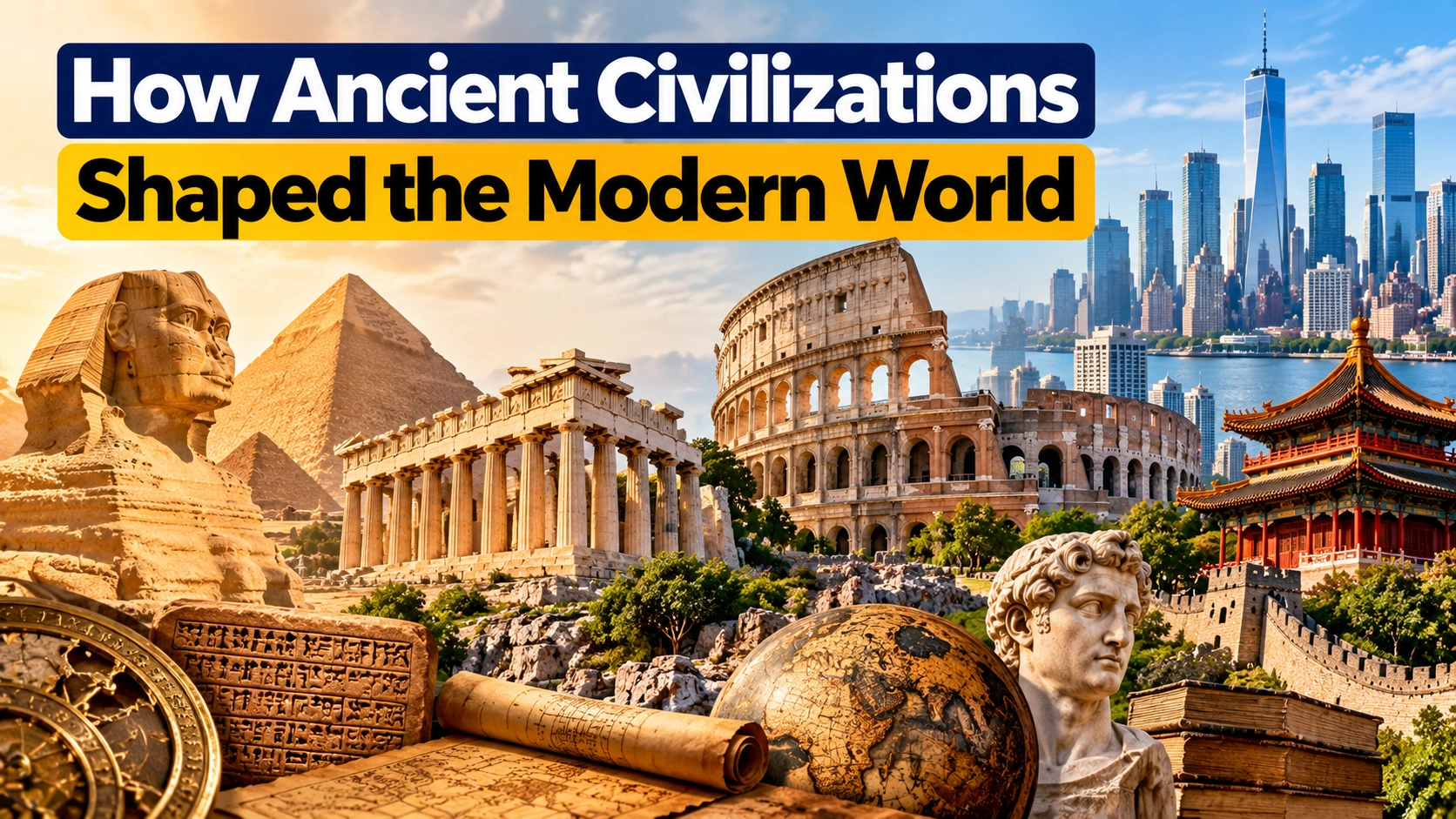
How Ancient Civilizations Shaped the Modern World

September 28, 2026
Modern society has been influenced by civilizations that existed thousands of years ago. Ancient communities developed systems of writing, government, architecture, mathematics, trade, agriculture, philosophy, and law that shaped later societies. While the modern world is very different from the ancient world, many ideas and practices can be traced through centuries of development.
Studying ancient civilizations is therefore more than learning about the past. It helps explain how some of the institutions, technologies, and cultural traditions that exist today developed over time.
The Development of Writing
Writing was one of the most important developments of early civilizations. Ancient societies created systems for recording information, including administrative records, laws, religious texts, commercial transactions, and historical events.
Mesopotamian societies developed cuneiform, one of the earliest known writing systems. In ancient Egypt, hieroglyphic writing was used for religious, administrative, and commemorative purposes.
Writing allowed information to be preserved beyond a single person’s lifetime. It also made it possible for governments and businesses to maintain more detailed records.
Modern systems of communication are vastly more advanced, but the fundamental idea of recording and transmitting information has ancient roots.
Agriculture and Organized Communities
Agriculture played a major role in the development of permanent settlements. Communities that could produce and store food were able to support larger populations and develop specialized occupations.
The civilizations that developed around the Nile, Tigris-Euphrates, Indus, and other river systems benefited from agricultural production and water management.
As settlements became larger, people developed systems for irrigation, storage, trade, construction, and administration. These developments contributed to the growth of cities and more complex societies.
Mathematics and Scientific Knowledge
Ancient civilizations made important contributions to mathematics and practical science. Mathematics was used for construction, trade, land measurement, taxation, astronomy, and calendars.
Ancient Egyptians used mathematical knowledge in architecture and land administration. Mesopotamian scholars developed sophisticated methods for calculation and astronomical observation. Indian mathematicians and scholars later made major contributions to mathematical concepts, including the development and spread of the decimal place-value system and the concept of zero.
These traditions became part of a much longer history of mathematical development that eventually contributed to modern science, engineering, finance, and technology.
Architecture and Engineering
Ancient architecture demonstrates how early societies solved complex engineering problems with the tools available to them.
The pyramids of Egypt, Roman roads and aqueducts, Greek temples, and urban planning traditions in ancient cities demonstrate knowledge of construction, geometry, materials, and organization.
Ancient engineering was often connected to practical needs such as transportation, water supply, agriculture, defense, and public buildings.
Modern engineers use technologies unavailable to ancient builders, but many fundamental principles involving measurement, structural design, and resource management remain important.
Law and Government
Ancient societies also developed systems for organizing communities and resolving disputes. The Code of Hammurabi, created in ancient Mesopotamia, is one well-known example of an early written legal collection.
Ancient Greece contributed influential ideas about citizenship and forms of political participation, particularly in Athens. Roman institutions contributed to the development of legal traditions that influenced later European legal systems and other jurisdictions.
Modern legal and political systems are not direct copies of ancient models, but historical ideas about laws, citizenship, public institutions, and governance have influenced later political thought.
Philosophy and Intellectual Traditions
Ancient philosophers explored questions about ethics, knowledge, justice, government, nature, and human behavior.
Greek thinkers such as Socrates, Plato, and Aristotle influenced later philosophical and educational traditions. Ancient Indian and Chinese philosophical traditions also developed extensive ideas concerning ethics, society, knowledge, governance, and human life.
These intellectual traditions continued to be studied, debated, adapted, and challenged by later generations.
Trade and Cultural Exchange
Ancient civilizations were rarely completely isolated. Merchants, travelers, migrants, and conquerors moved goods and ideas between regions.
Trade networks connected communities across parts of Asia, Africa, Europe, and the Middle East. Spices, metals, textiles, agricultural products, technologies, languages, artistic styles, and religious ideas traveled along these routes.
Cultural exchange helped societies adopt and adapt ideas from one another. The modern global economy is much more interconnected, but the basic process of exchanging goods and ideas across long distances has ancient origins.
Urban Development
Ancient cities developed systems for housing, markets, public buildings, sanitation, transportation, and administration.
The Indus Valley Civilization, for example, is known for planned urban settlements and sophisticated drainage systems. Roman cities developed roads, water systems, public buildings, and marketplaces.
Modern cities face very different challenges, but urban planners continue to deal with many fundamental questions: how to organize transportation, water, housing, sanitation, public spaces, and services for large populations.
Cultural Traditions
Ancient civilizations also influenced modern art, literature, architecture, religion, languages, festivals, and cultural practices.
Stories and myths from ancient societies have continued to appear in literature, theatre, film, art, and popular culture. Architectural styles inspired by ancient Greece and Rome can still be seen in public buildings around the world.
Cultural influence is rarely a simple process. Later societies often reinterpret ancient traditions rather than simply copying them.
The Importance of Preserving History
Studying ancient civilizations also demonstrates how societies change. Some institutions survive for centuries, while others disappear or transform completely.
Archaeological discoveries, ancient manuscripts, inscriptions, monuments, and artifacts provide evidence about how people lived and organized their societies.
Preserving this evidence allows researchers to understand both the achievements and challenges of earlier civilizations.